
What Enclosure Air Conditioner Short Cycling Looks Like
The cooler starts, the cabinet cools quickly, the thermostat is satisfied, the cooler stops. Four minutes later it starts again. Over a day that is a few hundred starts, and over a year it is a compressor that has done far more work starting than running.
Enclosure air conditioner short cycling is usually read as a fault. On an enclosure cooler it is more often a sizing decision showing its consequences, and the fix is rarely a replacement part.
A cooler that is twice the size of the load will spend most of its life starting and stopping, no matter how good the controller is.
Why It Happens
An enclosure holds very little thermal mass compared with a room. Air, some steel, a few kilograms of electronics. When a cooler with excess capacity runs, that small mass reaches set point in minutes, so the run time is short by construction.
- Oversizing. The most common root cause: capacity chosen with a large margin on top of an already conservative heat load.
- Narrow deadband. A controller that switches off at set point and on again 1 K later produces frequent, short runs.
- Sensor placement. A sensor in the cold discharge stream sees set point long before the cabinet does.
- Load variation. Equipment that idles most of the time and bursts occasionally leaves the cooler oversized for the common case.
- Airflow faults. Restricted flow can trip protection devices, producing cycling that looks like oversizing but is not.
Why It Matters
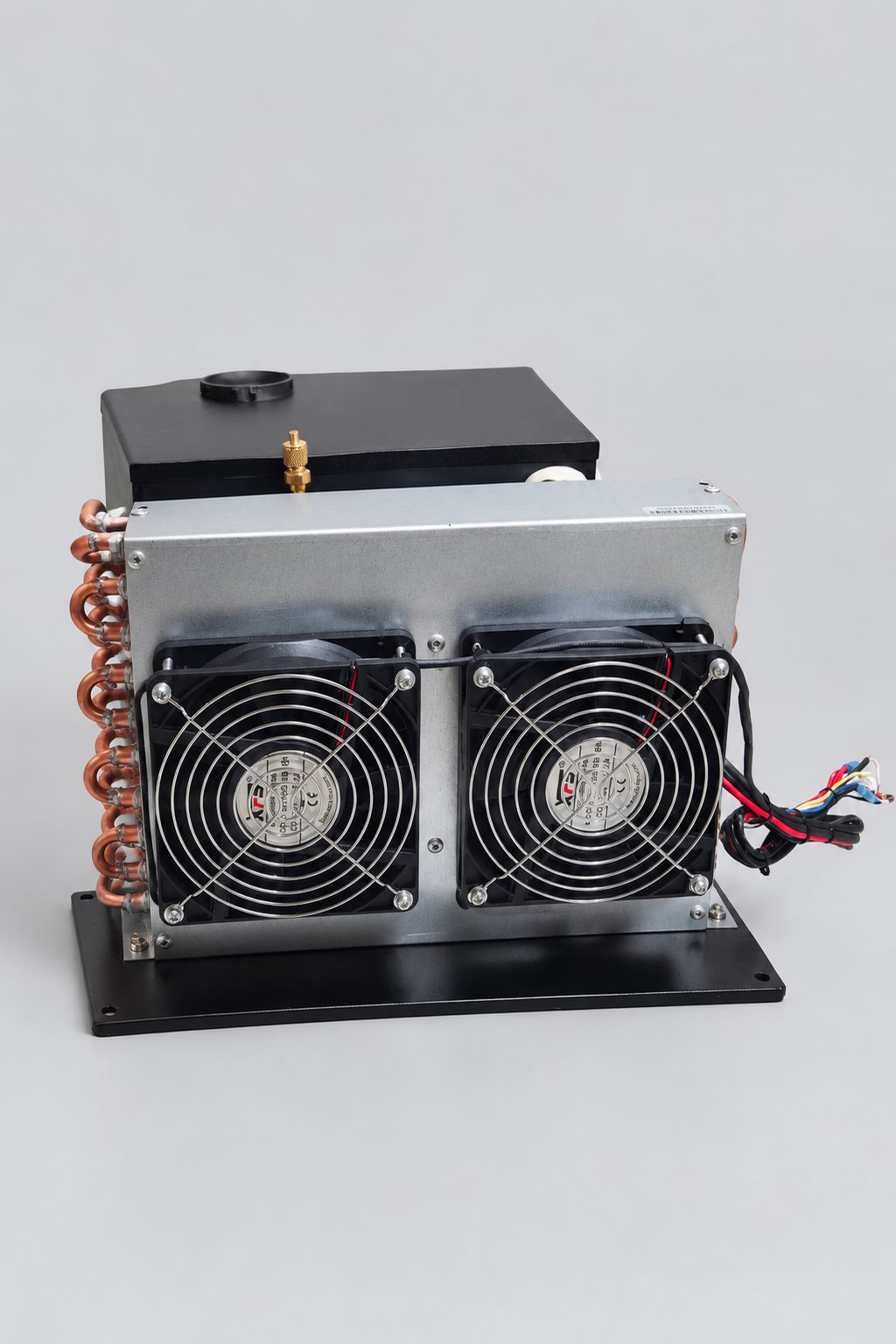
The numbers below are the reasons enclosure air conditioner short cycling is worth engineering out rather than tolerating.
| Consequence | Mechanism |
|---|---|
| Compressor wear | Starting loads and lubrication are hardest at start; frequent starts concentrate that wear |
| Poor moisture removal where moisture is present | Condensation needs surfaces below the dew point for sustained periods, and short runs give fewer such minutes; whether the cabinet is actually damp also depends on infiltration, door openings and absolute humidity |
| Temperature swing | Cabinet temperature oscillates instead of holding, which stresses components at both ends |
| Electrical stress | Repeated starting current on DC systems loads cabling, fuses and batteries, by an amount that depends on the drive's starting behavior |
| Apparent inefficiency | Energy goes into repeated pull-downs rather than steady removal |
The moisture consequence is the one that damages electronics. A cooler that never runs long enough to condense water keeps the cabinet cool and damp, and the condensation then happens on whatever surface is coldest, which is usually not the drain pan. Our guide to dew point in sealed enclosure cooling covers where that water ends up.
Telling Oversizing From a Fault
Before changing hardware, separate the three patterns that all look like enclosure air conditioner short cycling.
| Pattern | Likely cause | Check |
|---|---|---|
| Runs a few minutes, stops on set point, restarts regularly all day | Oversized or deadband too narrow | Compare measured heat load with cooler capacity; read the controller deadband |
| Stops after seconds, restarts immediately, sometimes with an alarm | Protection tripping: airflow, pressure, current or voltage | Check filters, condenser, supply voltage under load and any fault codes |
| Cycling only at certain times of day | Load or ambient variation | Log cabinet load and ambient across 24 hours |
Voltage matters more on DC installations than people expect: a supply that sags at start can trip protection and produce a cycling pattern that has nothing to do with capacity.
What the Controller Can Fix
Some cycling can be tuned out without touching capacity.
- Widen the deadband. Letting the cabinet drift 3 to 5 K instead of 1 K lengthens both run and off periods, which is the direct way to reduce start frequency. Check the allowed range against the compressor and controller requirements.
- Add or lengthen a minimum run time and a minimum off time if the controller supports them, within the range the equipment allows; these timers do not replace temperature or compressor protection.
- Move the sensor out of the discharge stream to a point that represents the cabinet.
- Raise the set point toward the highest temperature the electronics tolerate. This reduces the load, which lengthens off periods and shortens runs, so it cuts start frequency only alongside a sensible deadband; the goal is fewer starts and stable temperature, not longer runs for their own sake.
Check what the limits actually need to be. Cabinets are routinely set to 25 °C because it sounds safe, when the components inside are rated well above that and the real constraint is condensation, not temperature.
What Variable Speed Changes
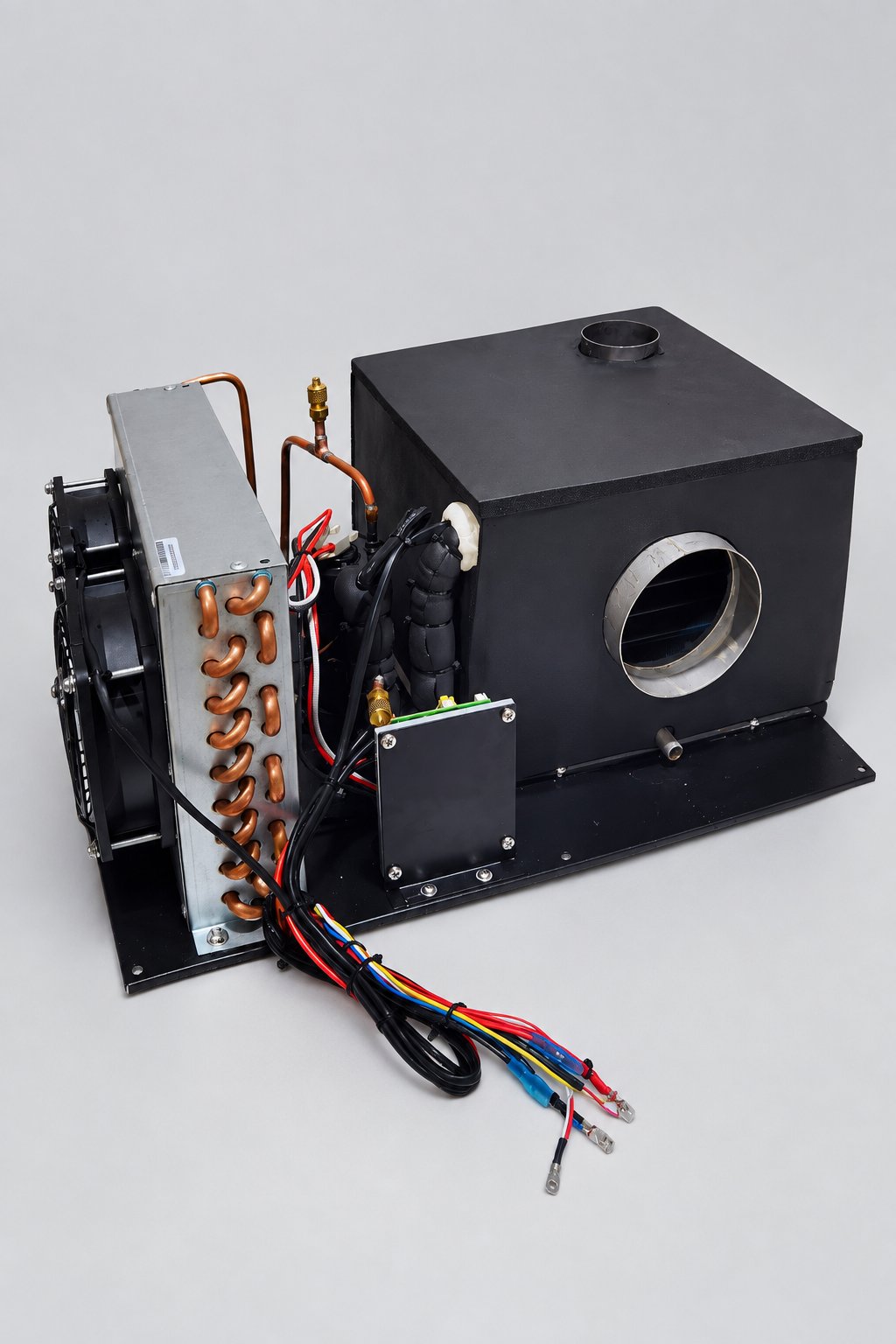
Variable speed changes the picture, because a compressor that can slow down does not have to stop.
RIGID's Micro DC Aircon modules use a brushless DC compressor with a variable speed range listed as 2,000 to 6,500 rpm, at 450 W for the 12 V, 24 V and 48 V models and 550 W for DV3220E-AC. A published speed range is not by itself closed-loop capacity control: confirm for the specific model how speed is commanded, what the control input is, and what cooling capacity remains at minimum speed in your conditions.
Two caveats belong with that. First, minimum speed is still a floor: below the load it represents, the unit cycles anyway. Second, running continuously at minimum speed in a lightly loaded cabinet is the condition that leads to a cold coil, so the fix for cycling can create a different problem if the cabinet load is genuinely tiny.
Sizing to Avoid It in the First Place
The cure is applied at specification time, and it is arithmetic rather than judgement.
- Total the real dissipation of the equipment at its normal duty, not its nameplate maximum.
- Add conduction through the walls at design ambient, and solar gain if the cabinet is outdoors.
- Choose the internal temperature limit from the weakest component.
- Select capacity close to the calculated load rather than the next size up on principle.
- Where load varies widely, discuss modulation or staging rather than covering the peak with one large unit.
- Confirm capacity at design ambient, because a figure quoted at laboratory conditions overstates what is available on a hot day.
Margin is not free. It is paid for in cycling, in humidity and in compressor life.
Condensate and the Damp Cabinet Problem
Where short cycling has been running for months, moisture is usually already in the cabinet.
- Check for water marks below the coil and on the cabinet floor.
- Inspect connectors and terminal blocks for corrosion, which is the slow damage that follows damp air.
- Compare whether the drain has carried water with the cabinet's known moisture sources. A dry drain is expected in a well-sealed cabinet with little infiltration, and is a warning only where moisture is known to be entering.
- Review the seal condition on doors and cable entries, since infiltration adds a continuous moisture load.
Practical arrangements for handling that water are covered in condensate management strategies for enclosures.
A Worked Sizing Check
The quickest way to settle whether a cooler is oversized is to redo the load calculation with measured numbers. The example uses assumed values; substitute your own.
| Input | Assumption | Result |
|---|---|---|
| Measured electrical draw of equipment inside | 180 W at normal duty | 180 W of heat |
| Cabinet surface | 3.2 m², painted steel, indoors | — |
| Ambient to internal difference | 35 °C room, 40 °C internal limit | Heat flows outward at the limit, counted as zero: a conservative upper bound for sizing, not a value to use when diagnosing an installed unit |
| Door openings and infiltration | Occasional, assumed 20 W average | 20 W |
| Total design load | — | about 200 W |
| Installed cooler | 450 W class | Roughly twice the load |
A ratio like that is a mismatch indicator, not proof of short cycling. On a fixed-speed machine it sets a duty cycle of roughly 200/450, about 44%; the cycle length itself comes from the cabinet's effective thermal capacity and the controller deadband, approximately capacity × deadband ÷ (cooling − load) for the run and capacity × deadband ÷ load for the off period. A heavy cabinet with a wide deadband can carry a 2:1 mismatch at acceptable cycle lengths; a light one with a 1 K deadband cannot.
The humidity consequence follows the same arithmetic: a unit running less than half the time has fewer minutes in which to condense water, which matters where the cabinet has a moisture source.
Logging Before Changing Anything
Controller settings are easy to change and easy to change back wrongly, so record the baseline before treating enclosure air conditioner short cycling with any adjustment.
- Log cabinet temperature, ambient and cooler state for 24 hours at one-minute resolution.
- Count starts per hour across the day, and note when the pattern changes.
- Record the existing set point, deadband and any minimum run or off timer.
- Measure supply voltage at the unit during a start, especially on battery-backed DC systems.
- Note whether the drain produced water during the day.
With that in hand, one change at a time tells you what worked. Widening the deadband and raising the set point together makes it impossible to know which mattered, and the next engineer inherits the confusion.
Staging, Redundancy and Wide Load Swings
Some cabinets genuinely swing between a near-idle load and a short, heavy peak. One cooler sized for the peak will cycle through most of the week, and one sized for the average will fall behind during the burst.
- Two smaller units let one carry the base load continuously while the second starts only for peaks. The pair also gives partial redundancy, which one large unit never does.
- Where redundancy is the point rather than a bonus, alternate the lead unit on a timer so both accumulate similar running hours.
- If the peak is short and predictable, thermal mass can absorb it: a cabinet that is allowed to drift upward during a ten-minute burst may not need capacity for the burst at all.
- Where the load will grow later, plan the second unit's mounting position now rather than oversizing today for a load that may never arrive.
The same logic applies to seasonal swings. A cabinet in a heated building may need almost no cooling in winter, and a unit sized for August will cycle hard in January unless the controller can modulate or the installation can stage.
What to Tell the Supplier
Whether you are specifying a new installation or arguing about an existing one, the same six numbers move the conversation forward.
- Measured internal dissipation at normal duty, not the sum of nameplate ratings.
- Cabinet dimensions, construction and whether it stands indoors or outdoors.
- Design ambient for the site and the season that matters.
- The internal temperature limit and where it comes from.
- The humidity conditions the cabinet sees, including door opening frequency.
- Observed starts per hour, if the unit is already installed.
With those, capacity can be matched to load instead of to habit, and enclosure air conditioner short cycling stops being something to tune around.
Common Mistakes
- Buying the next size up as a safety margin and creating a cycling problem.
- Reading cycling as a compressor fault without checking load and deadband.
- Setting the cabinet to 25 °C when the components tolerate considerably more.
- Mounting the sensor where it sees discharge air.
- Reading a published speed range as proof of automatic capacity matching.
- Ignoring the moisture that short cycling leaves behind.
If you suspect enclosure air conditioner short cycling because a cabinet cooler cycles every few minutes and you are not sure whether it is oversized or faulty, send us the cabinet dimensions, the internal dissipation, the set point and the controller settings. Ask our engineers to check a cycling installation.
Frequently Asked Questions
How many starts per hour is too many?
There is no universal number; compressor and drive makers publish their own limits, and the controller should enforce them. Rather than a rule of thumb, compare the observed pattern against the limit for your compressor, and read cycle length together with cabinet temperature stability.
Can I fix short cycling by widening the deadband?
Often, yes, and it is the cheapest first move. Letting the cabinet swing a few kelvin wider multiplies run time. It only fails when the equipment genuinely needs a tight band or the cooler is grossly oversized.
Does an oversized cooler at least keep the cabinet cooler?
It keeps the air cool and damp. Because it never runs long enough to condense much water, humidity stays high, and the coldest surface in the cabinet becomes the condensing surface.
Is cycling a problem on variable speed units?
Less so, because the compressor can slow down instead of stopping. Below its minimum speed the unit still cycles, and a very lightly loaded cabinet can push a modulating unit into a cold-coil condition instead.
Could low voltage cause this?
Yes. On DC installations, a supply that sags during start can trip protection and produce rapid restarts that look like a capacity problem. Measure voltage at the unit during a start before concluding anything about sizing.
What should I do with a cooler that is already oversized?
Tune what you can, widen the deadband, raise the set point to the real limit and check sensor placement. If the mismatch is large, replacing the unit with correctly sized capacity is the only durable answer.
References
- Leipole Electric, How to Size a Cabinet Air Conditioner — internal load, ambient difference and why an oversized unit short cycles and leaves condensation in the panel.
- Trane, AC Short Cycling: Why It Happens — cycling causes, wear mechanisms and the role of correct sizing.